

Some of the strongest social media content doesn’t look much like marketing at all.
No celebrity influencer.
No carefully polished corporate script.
No expensive production designed to make every frame look perfect.
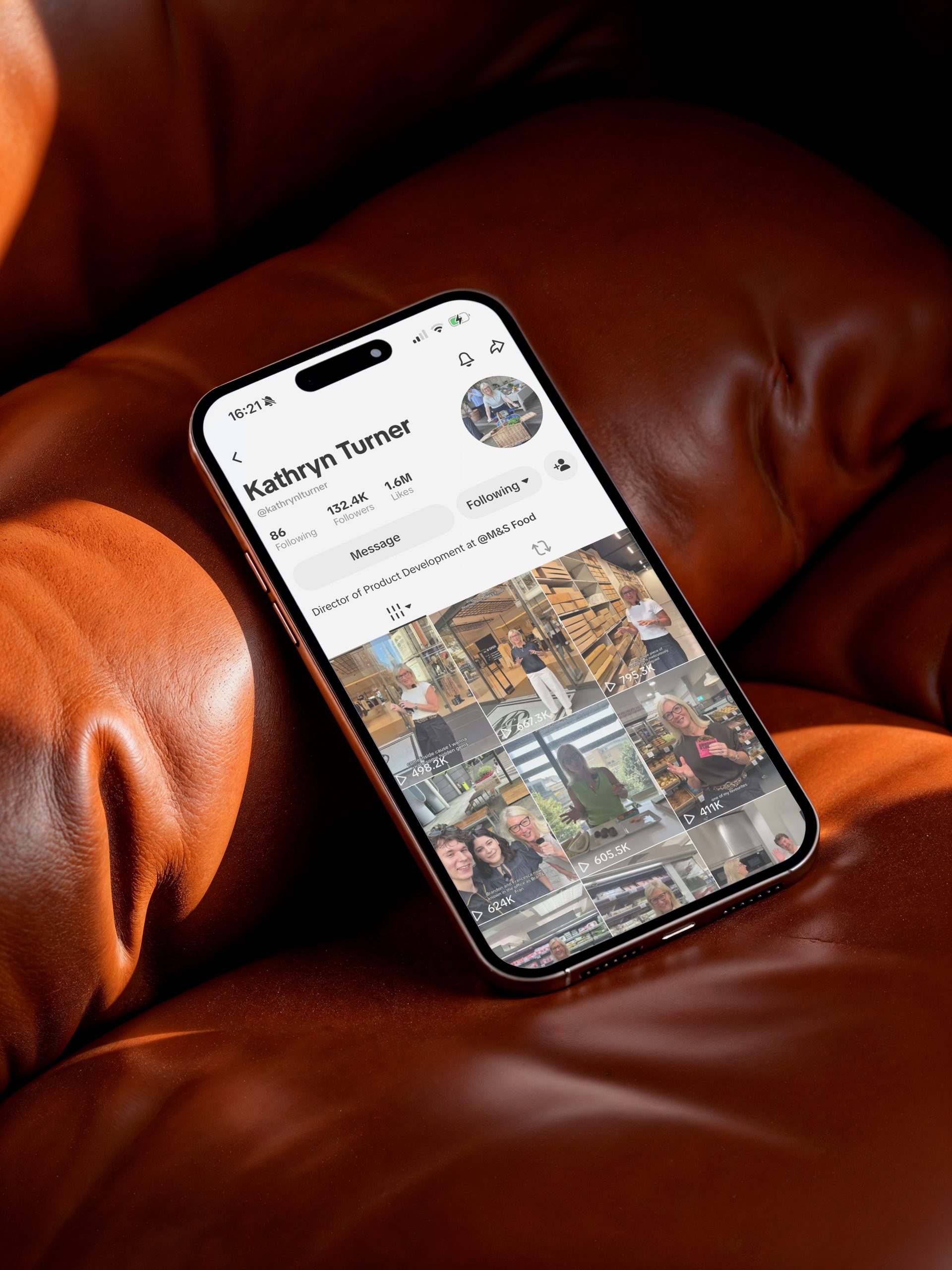
Instead, one of the most interesting examples of brand content we’ve seen recently has come from Kathryn Turner, Director of Product Development at Marks and Spencer Food.
Kathryn began sharing behind-the-scenes videos on TikTok in May 2026, taking viewers around M&S Foodhalls, sharing products she recommends, introducing people involved in product development and giving customers access to stories they would rarely see through traditional advertising.
The response has been significant.
Within less than a month, Kathryn’s account had attracted almost 50,000 followers. Her introductory video alone generated more than a million views, and her content has continued to attract substantial engagement since.
But the numbers aren’t really the most interesting part.
It’s why people want to watch her.
M&S already had the products.
It already had the expertise.
It already had the stories.
What changed was who was telling them.
Kathryn Turner is Director of Product Development at M&S Food and has worked within the business since 1995.
Her role puts her close to the development and innovation behind the food customers see on shelves every day. M&S itself regularly features Kathryn as a product development expert when announcing new ranges and explaining the thinking behind its food products.
That distinction matters.
She isn’t an influencer learning a product brief before filming.
She understands the products.
She knows the people responsible for developing them.
She understands why decisions were made.
And she has stories that somebody outside the organisation simply wouldn’t have access to.
Her TikTok account gives that knowledge somewhere to go.
Why does the content work?
It would be easy to say Kathryn’s content succeeds because it’s authentic.
That’s part of it.
But plenty of informal videos are uploaded every day without attracting meaningful attention.
The more important point is that Kathryn has something worth saying.
She has experience.
She has access.
She has genuine enthusiasm for the products.
And she understands the subject in considerably more depth than someone simply reading an advertising script.
The informal format allows those things to come through.
That’s an important distinction for businesses and charities thinking about their own social media strategy
Authenticity isn’t simply filming something on a phone.
It’s allowing genuine expertise and personality to survive the marketing process.
What is employee-generated content?
Most organisations are already familiar with user-generated content, usually shortened to UGC.
UGC involves customers, supporters or members of an organisation’s wider audience creating content about a brand, product or experience.
Employee-generated content, or EGC, takes that idea inside the organisation.
Employees become visible participants in telling the organisation’s story.
That could mean sharing specialist knowledge.
Showing people behind the scenes.
Explaining how something works.
Demonstrating a product.
Answering questions customers repeatedly ask.
Or introducing people to parts of the organisation they would rarely see otherwise.
Kathryn’s content is a particularly effective example because product development is her actual area of expertise.
The knowledge isn’t being manufactured for social media.
Social media is simply giving existing expertise a distribution channel.
Employee-generated content is different from influencer marketing
Influencer marketing can be extremely effective.
Creators bring audiences, established communication styles and credibility with communities that organisations may otherwise struggle to reach.
M&S itself has used TikTok creators successfully within previous advertising campaigns. One TikTok for Business case study reports more than 18.5 million impressions for an M&S Valentine’s campaign using creator content. TikTok’s M&S case study demonstrates that influencer-led content already forms part of the retailer’s wider approach to the platform.
But employee-generated content offers something different.
An influencer can tell you why they like a product.
Someone involved in creating it can tell you why it exists.
That creates another type of authority.
Kathryn doesn’t become interesting because M&S has turned her into an influencer.
She becomes interesting because she already has decades of experience and knowledge that people want access to.
Your best content creators might already work for you
When organisations decide they need more video content, the conversation often starts with:
Who are we going to get to present it?
Perhaps the better question is:
Who already knows something our audience would find useful?
For a professional services business, that might be somebody answering the same complicated client question every week.
For a manufacturer, it could be somebody explaining how a product is made.
For a digital agency, it might be a developer talking through why a website has been built in a particular way.
For a school, it could be a teacher explaining what makes a particular programme different.
For a charity, the opportunity can be even greater.
A fundraiser can explain where donations actually go.
A volunteer coordinator can answer questions potential volunteers are nervous about asking.
A service delivery colleague can explain how somebody accesses support.
An events team can take supporters behind the scenes of a major fundraising event.
A CEO can explain why the organisation has made a particular decision.
These people don’t necessarily need to become professional content creators.
They already possess the valuable part.
Something worth talking about.
For charities thinking about how social media supports fundraising, volunteer recruitment and supporter engagement, this can become an important part of a wider charity marketing strategy.
Why EGC can feel more trustworthy than polished brand content
Highly produced content still has an important place.
Campaign films, paid advertising, case studies and major brand content may benefit enormously from professional photography and video production.
But not every Reel, TikTok or LinkedIn video needs to look like an advert.
Sometimes excessive production creates distance between the organisation and the audience.
People are increasingly good at recognising marketing.
They recognise influencer scripts.
They recognise corporate language.
They recognise a video where every sentence feels like it has been through several rounds of approval.
Employee-generated content can create a different relationship.
You’re hearing directly from somebody inside the organisation.
The expertise feels closer.
The personality is more visible.
And the organisation begins to feel less like a logo and more like a group of people.
This is particularly relevant at a time when organisations are also producing more content using generative AI.
As we explored in our article on what AI watermarking means for businesses using AI-generated content producing content has never been easier.
That potentially makes genuine experience more valuable.
Anyone can ask an AI tool to produce a post about product development.
Far fewer people can talk about actually developing the product.
Authentic doesn’t mean unplanned
This is where organisations can easily learn the wrong lesson.
Kathryn’s videos feel informal.
That doesn’t necessarily mean there is no thought behind them.
The account has a recognisable purpose.
The subject matter is consistent.
There is a reason for people to follow.
Videos revolve around M&S Food, products, development, recommendations and the people responsible for creating them.
The content supports the organisation without removing Kathryn’s personality.
That’s the balance brands should be looking for.
Strategic enough to have a purpose.
Natural enough that people still want to watch it.
A good social media management strategy should still establish your audiences, objectives, content themes and measures of success.
Employee-generated content is part of that strategy.
It isn’t an alternative to having one.
UGC and EGC work in different ways
User-generated content and employee-generated content can both help organisations communicate in a more human way.
But they provide different forms of credibility.
UGC gives you the perspective from outside the organisation.
A customer talks about using a product.
A supporter explains why they fundraise.
A volunteer shares their experience.
EGC provides the perspective from inside.
Someone explains why the product was developed.
A fundraiser shows what happens behind the campaign.
A member of the service team explains how support is delivered.
Neither is necessarily stronger than the other.
Used together, they can create a much more complete picture of an organisation.
The brand provides the strategy.
Employees provide expertise and access.
Customers, supporters and volunteers provide lived experience.
There is a particularly strong opportunity for charities
Charity marketing teams are often relatively small.
But the organisations themselves contain enormous amounts of specialist knowledge, experience and stories.
The challenge is that much of that expertise never makes it into marketing.
Instead, social feeds can become dominated by campaign graphics, awareness days, fundraising appeals and event posters.
Those things have a place.
But they don’t always allow people to get to know the organisation.
Employee-generated content provides another option.
A hospice could introduce some of the people providing care.
A disability charity might allow specialist team members to explain common misconceptions.
A volunteer manager could explain what somebody should expect on their first day.
A fundraiser could show the work behind an event.
A charity shop team could take people behind the scenes of sorting donations.
Used appropriately, this can help build the trust and familiarity that supports future action.
Someone might see a volunteer talking about their experience today and apply several months later.
Someone might begin following a fundraiser before eventually attending an event.
Someone may discover a service because a member of the team answered a question they were already asking.
This is similar to the principle we discussed when looking at how Meta Ads can help charities recruit volunteers.
Awareness has much greater value when there is a meaningful journey behind it.
There still need to be boundaries
Employee-generated content shouldn’t mean uncontrolled content.
Organisations still need appropriate safeguards.
Confidential information must remain confidential.
Employees need to understand what can and cannot be discussed.
Regulated sectors may have specific compliance requirements.
Charities need to consider safeguarding, consent and the dignity of service users.
And employees shouldn’t suddenly be expected to become public-facing content creators simply because they work for the organisation.
The objective is to create enough structure to protect everybody involved without removing the personality that made the format useful in the first place.
Too little control creates risk.
Too much control can remove the reason the content works.
Don’t turn your experts into corporate presenters
One of the easiest ways to undermine employee-generated content is to give somebody a script that sounds nothing like them.
If an employee is naturally knowledgeable and enthusiastic about a subject, they probably don’t need a 300-word monologue written by marketing.
Give them the subject.
Agree the important points.
Explain any boundaries.
Ask a good question.
Then let them answer it.
The marketing team can provide the structure around them.
Filming.
Editing.
Captions.
Brand consistency.
Distribution.
Measurement.
The objective should be to make expertise easier to consume, not to replace somebody’s personality with corporate language.
Production quality and content quality are not the same thing
Professional production can make content considerably stronger.
We provide photography and video for exactly that reason.
But professional production should support the idea rather than become the idea.
Short-form social media often benefits from feeling immediate.
A smartphone, good audio, appropriate lighting and somebody with something genuinely useful to say can sometimes outperform a considerably more expensive piece of content.
The question shouldn’t always be:
How can we make this look more professional?
Sometimes it should be: How can we make this more useful or interesting?
The comments can become part of your content strategy
One of the biggest advantages of this type of content is that audiences can tell you what they want next.
They ask questions.
Request recommendations.
Share experiences.
Challenge something that was said.
Ask to see another part of the organisation.
That shouldn’t simply be reported as engagement.
It is audience insight.
If ten people ask the same question underneath a video, that’s probably your next video.
If customers repeatedly ask about a particular product, there’s probably more content to create around it.
If potential volunteers keep raising the same concern, the organisation has identified something its wider communications should address.
Social media becomes much more useful when organisations stop treating it solely as a publishing platform and start using it as a source of insight.
Don’t judge employee-generated content by views alone
Kathryn’s viewing figures make the example easy to talk about.
But most organisations shouldn’t be trying to reproduce millions of views.
Reach only matters when it reaches somebody useful.
For a specialist B2B organisation, 1,500 views from relevant decision-makers may be extremely valuable.
For a local charity, a video seen by 5,000 people in its catchment area could generate volunteer applications or event registrations.
For a school, reaching a few hundred local parents might contribute towards admissions.
The objective determines what success means.
This is why we generally encourage organisations to measure social media against meaningful outcomes rather than simply reporting follower numbers and impressions.
Your wider marketing strategy should determine whether you’re trying to generate awareness, enquiries, registrations, applications, donations or another action.
Views tell you somebody watched.
They don’t automatically tell you whether the content worked.
The opportunity isn’t to find your own Kathryn Turner
This is probably the easiest mistake for organisations to make.
The answer isn’t to copy the format.
M&S doesn’t need ten people imitating Kathryn.
And another business doesn’t need to find somebody who behaves exactly like her.
What makes the example useful is that Kathryn’s content feels specific to her role, knowledge and personality.
Your opportunity will be different.
Who has genuine expertise?
Who naturally explains things well?
Who is enthusiastic about what they do?
Who has access to something outsiders rarely see?
What happens inside your organisation that you’ve stopped finding interesting because you experience it every day?
Those are much better questions than:
What should we post this week?
People connect with people
M&S already had a recognisable brand.
It already had successful products.
It already had established social channels.
Kathryn Turner’s content hasn’t replaced any of those things.
It has added another layer.
A person.
Someone with knowledge, enthusiasm and access who audiences can begin to recognise and trust.
That’s the real lesson businesses and charities can take from the example.
Your organisation is probably already full of expertise.
The marketing opportunity is making more of that expertise visible.
At Blake Mark Productions, we support businesses and charities with social media management, content strategy and photo and video production, helping organisations create content built around genuine objectives rather than publishing for the sake of filling a social calendar.
If your organisation is looking at its social channels and wondering how to create more engaging content, it might be worth starting somewhere other than the marketing department.
The person your audience wants to hear from could already work for you