

Website performance used to be treated mainly as a technical issue, something for developers to think about once a website had been designed and launched.
That is no longer a useful way to look at it.
How quickly a website loads, how stable it feels, how well it performs on mobile and how reliably its forms and interactive elements work can influence almost every part of its effectiveness. Performance can affect search visibility, conversion rates, paid advertising efficiency, accessibility and the overall experience people have with an organisation online.
For businesses, charities and other organisations that rely on their website to generate enquiries, process donations, recruit volunteers or provide information, website performance is therefore much more than a technical metric.
It has become part of how well the website does its job.
What do we mean by website performance?
Website performance is often reduced to one question: how fast does the website load?
Speed is an important part of it, but performance is broader than that. A well-performing website should load important content quickly, respond promptly when somebody interacts with it and remain visually stable while the page is loading. It should also behave consistently across different devices, particularly mobile.
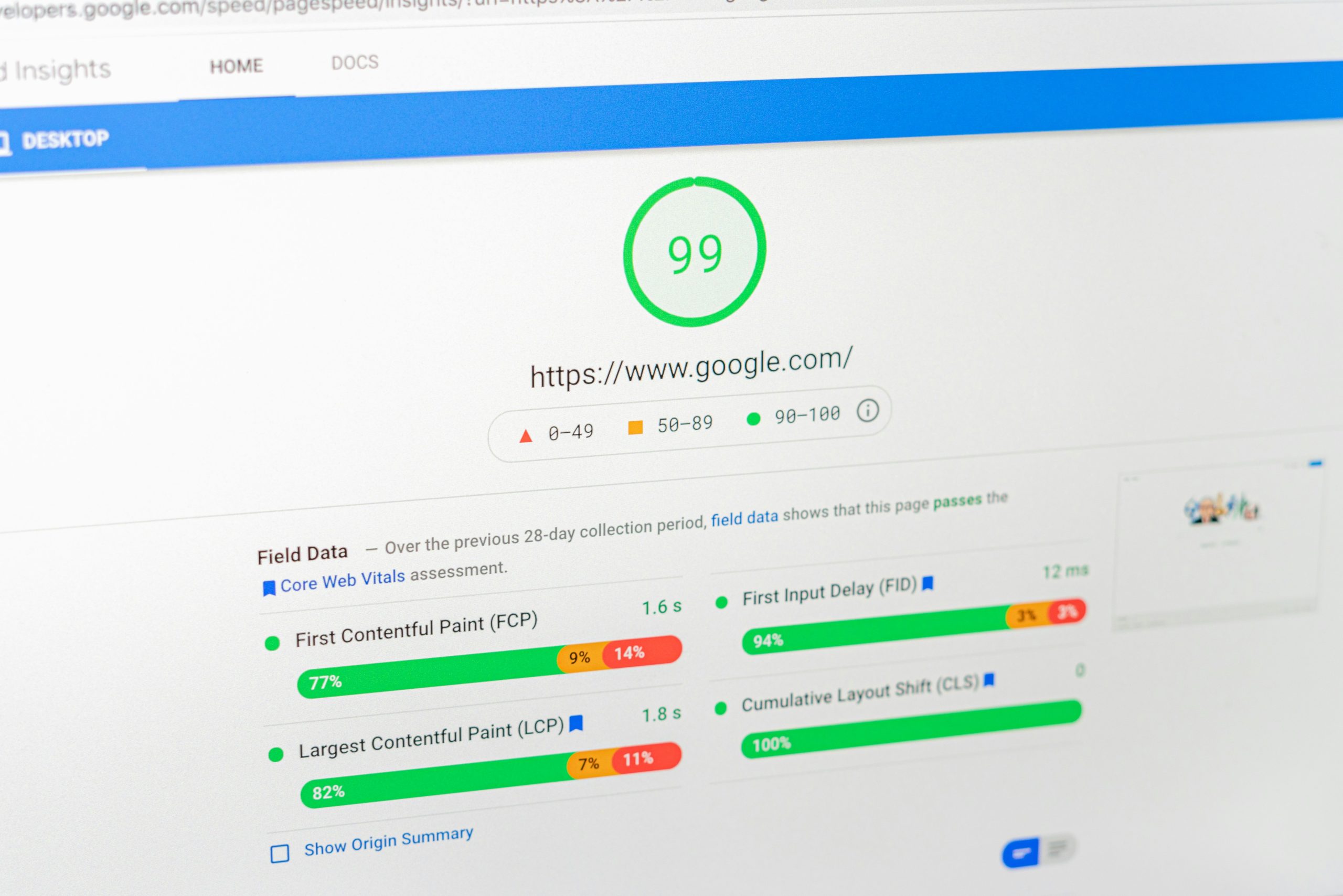
Google’s Core Web Vitals are designed around some of these aspects of user experience. They currently include Largest Contentful Paint, which looks at loading performance; Interaction to Next Paint, which considers responsiveness; and Cumulative Layout Shift, which measures unexpected movement of content while a page is loading.
You can read more in Google’s guidance on Core Web Vitals.
These measures are useful because they move the conversation beyond a single load-time figure and towards the experience somebody actually has when using a website.
A page can technically load quickly and still feel poor to use if content moves around, buttons are slow to respond or the mobile experience is inconsistent.
Why does website performance matter?
A website rarely sits on its own.
It is often the destination for search traffic, paid advertising, social media, email campaigns, referrals and increasingly AI-led discovery.
That means the performance of the website can influence the value of all the activity driving people towards it.
Someone may click an advert and leave before the landing page finishes loading. A potential donor may abandon a donation journey because the page feels unreliable. A prospective customer may give up on a form that takes too long to respond or behaves poorly on mobile.
The issue is not simply that a slow website is frustrating.
It is that poor performance can create friction at the exact moment somebody is deciding whether to take the next step.
Website performance can affect SEO
Website performance is not the only factor that determines whether a page ranks well.
Content quality, relevance, technical structure, authority and search intent all matter.
But performance still forms part of the wider experience Google is trying to provide to users.
Google has included Core Web Vitals within its page experience guidance for several years, and poor performance can often sit alongside broader technical issues such as oversized images, inefficient themes, excessive scripts or weak mobile optimisation.
That is why performance should be considered as part of a wider SEO strategy rather than as a separate technical exercise.
Improving search visibility is only useful if the website people arrive on is capable of delivering a good experience once they get there.
Mobile performance matters even more
Performance problems are often most noticeable on mobile.
A website may feel perfectly acceptable when tested on a fast office connection and a high-spec laptop, but that does not necessarily reflect the experience of a real visitor.
Someone may be using an older phone, a slower mobile connection or accessing the website while travelling. Under those conditions, large images, background video, unnecessary animations and multiple third-party scripts can have a much more noticeable impact.
This matters because mobile is often where somebody first encounters an organisation.
If that first experience feels slow or unreliable, the website has created friction before the visitor has had a chance to understand what the organisation offers.
Mobile performance therefore needs to be considered as part of the design process itself, not something checked after the desktop version has been approved.
Website speed can affect conversions
The commercial impact of performance becomes clearer when you look at what the website is actually supposed to achieve.
For a service business, that might be generating enquiries. For an ecommerce website, it could be completing purchases. For a charity, it may be encouraging donations, volunteer applications or event registrations.
In every case, the visitor has to complete a journey.
A slow page, delayed form, unstable layout or unresponsive button can all interfere with that process.
That is why performance optimisation should not be viewed simply as an attempt to improve a technical score. The real objective is to remove unnecessary friction from the journey.
A technically fast website that is confusing or difficult to use is not automatically a good website either. Performance needs to work alongside clear messaging, useful content and straightforward calls to action.
Poor website performance can waste advertising spend
Performance becomes particularly important when organisations are paying for traffic.
Every click from Google Ads, Meta or another paid channel has a cost. If somebody arrives on a slow or unstable landing page, that cost has already been incurred before the website has had a chance to do its job.
This can make advertising less efficient, and the problem is easy to misdiagnose.
A campaign may generate plenty of clicks but relatively few enquiries. It is tempting to assume the targeting or ads are the problem, but sometimes the bigger issue sits after the click.
The page may load too slowly, the form may be difficult to use or the mobile experience may be poor.
That is why landing page quality matters just as much as the ad itself.
Website stability affects trust
Most visitors will never know what Core Web Vitals are.
They will not know whether an image has been properly compressed or whether a script is slowing the page down.
They will simply experience the result.
A website that loads quickly, responds properly and behaves predictably feels more dependable.
A website where content moves unexpectedly, buttons take time to respond or pages fail to load can feel less trustworthy.
That matters particularly for organisations asking people to share information, make payments or take an important action.
A charity asking somebody to donate needs the donation journey to feel reliable. A professional services business asking somebody to submit personal information needs the enquiry process to work properly.
Website performance therefore contributes to trust even when visitors never consciously think about speed.
Core Web Vitals are useful, but they are not the whole story
Tools such as PageSpeed Insights and Lighthouse can provide useful information about technical performance.
They are valuable diagnostic tools, but they should not become the only definition of whether a website performs well.
A website can achieve a strong Lighthouse score and still have confusing navigation. It can pass Core Web Vitals and still have a poor enquiry form. It can load quickly and still fail to explain what the organisation actually does.
The objective should therefore not be to chase a perfect score simply because a tool displays one.
Performance data needs to be interpreted alongside real user journeys and outcomes.
This is also why broader website assessment matters. Our free Website Visibility Checker looks at areas including technical discoverability, mobile performance, content clarity, AI search readiness, accessibility and trust rather than reducing website quality to one metric.
Why WordPress websites need ongoing performance attention
Website performance can change over time.
A WordPress website that performed well when it launched may gradually become slower as new content, plugins, tracking scripts and integrations are added.
Images may be uploaded without proper optimisation. Plugins may introduce additional scripts. Third-party tools may change how they load. New marketing technology may add more tracking.
Individually, each change may seem relatively small. Collectively, they can have a noticeable impact.
That is why performance should not be treated as something solved once at launch.
Regular maintenance helps identify emerging issues and makes sure the website continues to work properly as it evolves.
This wider role of ongoing support is explored in more detail in our article on why organisations invest in WordPress technical support.
Hosting plays a role too
The website itself is only one part of the performance equation.
The quality and configuration of the hosting environment can affect how quickly the server responds, how reliably the site remains available and how effectively it handles periods of higher demand.
That does not mean expensive hosting automatically creates a fast website. A poorly optimised site can still perform badly on good infrastructure.
But equally, there is a limit to how much optimisation can compensate for hosting that is consistently slow or under-resourced.
Website performance therefore needs to be looked at as a complete system, including hosting, the website platform, plugins, images, scripts and third-party integrations.
Performance is also becoming relevant to AI
The way websites are used is beginning to change.
For years, websites were largely designed around people and search engines. AI agents may increasingly become a third audience.
Google Chrome has already begun experimenting with Agentic Browsing checks in Lighthouse, looking at whether websites are structured and stable enough for AI agents to understand and interact with reliably.
One of the areas it considers is layout stability. If an element moves before an AI agent interacts with it, the agent can encounter the same type of problem as a human visitor.
We explore this in more detail in our article on building a website ready for AI agents.
This does not mean organisations need to start optimising exclusively for machines. The technology is still developing.
What it does reinforce is that clear structure, stable layouts and reliable interaction increasingly benefit more than one audience.
What should organisations actually monitor?
Website performance does not need to become a daily obsession.
For most organisations, the important thing is to understand the key indicators and investigate meaningful changes.
Core Web Vitals provide a useful starting point for loading, responsiveness and stability. Google Search Console can help identify issues across groups of URLs, while PageSpeed Insights and Lighthouse can provide more detailed diagnostic information.
Analytics, form testing and conversion data can then help show whether technical issues are affecting real behaviour.
The most useful monitoring combines technical information with outcomes.
A slightly slower score may not be urgent if the site continues to work well for users, while a small technical change that coincides with a drop in mobile conversions may deserve immediate attention.
Context matters.
Website performance is part of a good website
Website performance is not simply a developer metric.
It affects the results generated by SEO, influences what happens after somebody clicks an advert, shapes conversion journeys and contributes to the overall trust people place in a website.
It also needs to be considered alongside design, content, accessibility and the wider purpose of the site.
A website can look excellent and still perform poorly.
Equally, a fast website can still fail if it is difficult to understand or does not give people a clear route towards the next step.
The strongest websites bring those things together.
They are clear, useful, stable and easy to use.
That is why website performance matters more than ever.