
Free website audit tool

Free Website Visibility Checker

See how well your website is set up to be discovered, understood and used.

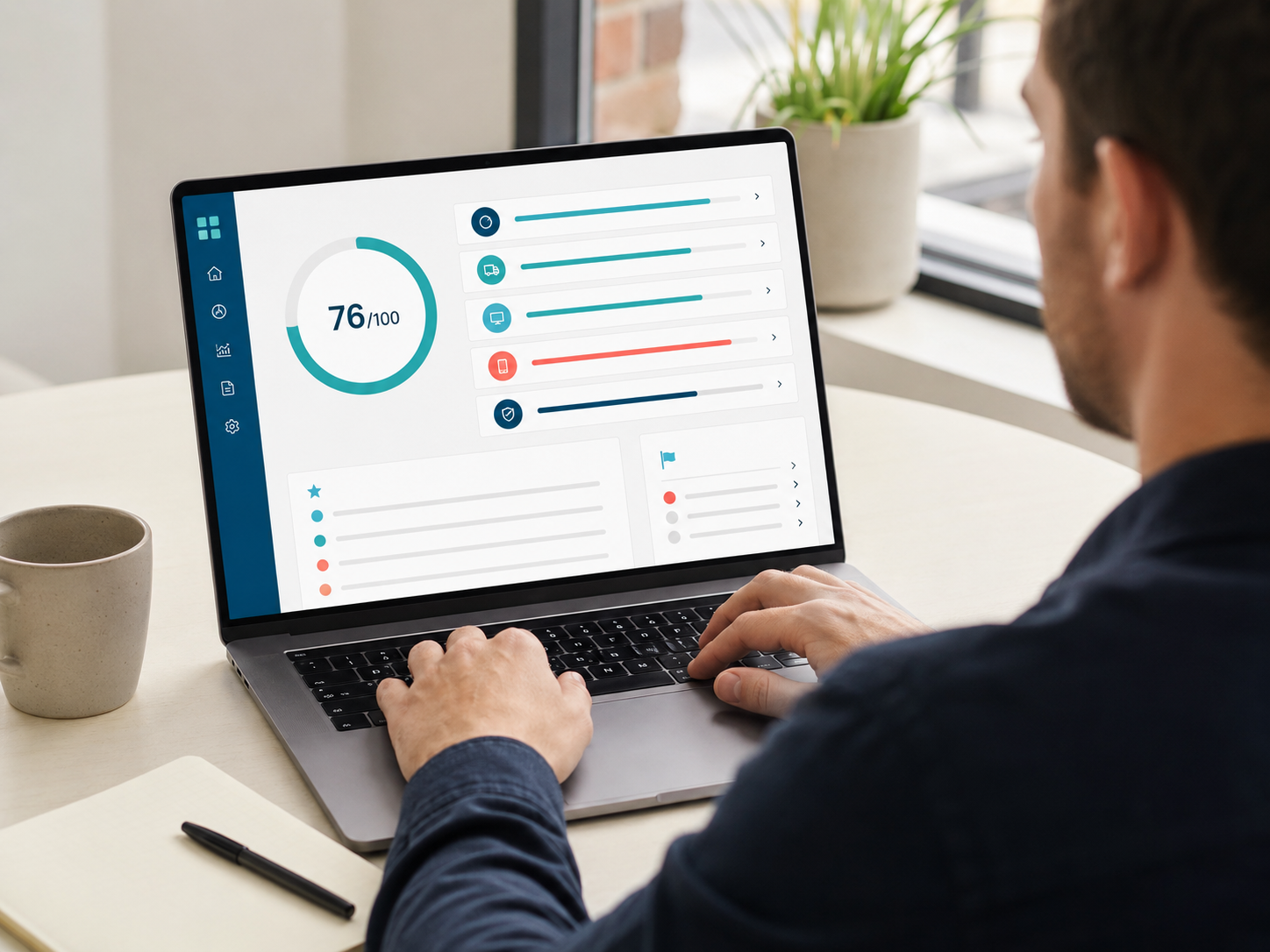
Our free Website Visibility Checker reviews the public-facing signals that support visibility across traditional and AI-powered search. It provides an instant score across technical SEO, mobile performance, content clarity, AI search readiness, accessibility and trust.

Free website visibility check

Is your website ready to be found by people and AI?

Enter your website address to receive an instant visibility score across SEO, performance, accessibility, content structure and AI search readiness.

No email address required. The first results are shown immediately.

Is your website ready to be found by people and AI?

Enter your website address to receive an instant visibility score across SEO, performance, accessibility, content structure and AI search readiness.

Website Visibility Checker FAQs

A website visibility score is a practical assessment of how well a website is set up to be discovered, understood and used by people and search systems.

Our score combines five areas: technical discoverability, mobile performance, content clarity, AI search readiness, and accessibility and trust. It provides a useful starting point for identifying strengths and deciding what to improve first.

The checker reviews a sample of publicly accessible pages and looks for signals including HTTPS, indexing directives, robots.txt, XML sitemaps, page titles, meta descriptions, canonical URLs, heading structure, internal links, visible content, structured data, organisation information, image alternative text and key trust pages.

It also uses Google PageSpeed Insights data, when available, to assess mobile Lighthouse performance and automated accessibility signals.

No. The tool does not submit prompts to ChatGPT, Gemini, Perplexity or other AI platforms, and it does not measure brand mentions or citations within their answers.

It assesses the public technical, structural and content signals that can make a website easier for search and AI systems to access and understand. That is why the result is described as AI search readiness rather than verified AI visibility.

Terms such as Generative Engine Optimisation, or GEO, are often used to describe work focused on visibility within AI-powered search. However, the same foundations still matter: crawlable pages, clear technical structure, useful original content, accurate organisation information and a strong user experience.

Google’s official guidance states that optimisation for generative AI search is still SEO. There is no single piece of special markup or quick fix that guarantees inclusion in an AI-generated result.

Yes. You can run a scan and view your initial visibility score without creating an account or entering an email address.

If you choose to receive the complete action plan by email, you will be asked for your name and work email address after the scan.


No. It is an automated assessment of a limited sample of publicly accessible pages.

It does not measure keyword rankings, backlinks, competitor visibility, conversions or live AI citations. Automated accessibility tests also cannot replace a manual review against the Web Content Accessibility Guidelines.

Use the score to identify priorities and start a more informed conversation, not as a substitute for a complete technical, SEO, content or accessibility audit.

Yes. The checker can assess any publicly accessible website, including charity, education, professional-services and service-based business websites.

The scoring focuses on common visibility foundations rather than sector-specific benchmarks. The commercial or organisational importance of each finding will still depend on what the website needs people to do, such as enquire, donate, apply, book or buy.

The score is based on the public HTML and technical data available at the time of the scan. Some websites block automated requests, rely heavily on JavaScript or prevent Google PageSpeed data from being returned, which can limit what is tested.

When a category cannot be tested, the tool excludes it from the overall calculation rather than inventing a result. Scores can also change as the website, hosting environment or external testing data changes.

Can people and search systems find, understand and trust your website?

A website can look professional and still be difficult to discover.

Pages may be blocked from indexing, important content may be buried, mobile performance may be weak, or search systems may struggle to understand what the organisation does and who it serves.

Website visibility is the ability of people and search systems to discover, interpret and use a website. It is influenced by crawlability, technical SEO, mobile performance, content structure, accessibility and the trust signals available across the site.

These elements do not work in isolation. A fast website with unclear content will still underperform. Strong content on pages that cannot be crawled will not be found. Structured data cannot compensate for a weak proposition or poor user experience.

The Website Visibility Checker brings these foundations together into one practical score, helping you see where the site is already strong and where focused improvements could make the greatest difference.


What does the Website Visibility Score measure?

The overall score combines five categories. Each category is weighted according to its role in helping people and search systems discover, understand and use the website.

Technical discoverability - 25%

Checks whether public pages can be accessed and interpreted by search engines. This includes HTTPS, indexing directives, robots.txt, XML sitemap discovery, page titles, meta descriptions, canonical URLs and primary headings.

Content clarity - 20%

Reviews whether important pages communicate a clear subject and provide useful, structured information. It considers page titles, headings, internal links, visible content, page coverage and search result summaries.

Accessibility and trust - 15%

Reviews automated Lighthouse accessibility data alongside image alternative text, declared page language, HTTPS and the presence of clear About, Contact and Privacy information.

Mobile performance - 20%

Uses available Google Lighthouse data to assess mobile performance, Largest Contentful Paint, Cumulative Layout Shift and Total Blocking Time. These signals help identify loading, stability and responsiveness issues that may frustrate visitors.

AI search readiness - 20%

Assesses the onsite foundations that can help search and AI systems access and interpret public information. This includes crawlability, JSON-LD structured data, organisation identity markup, About and Contact information, semantic content structure and visible evidence of useful expertise.

What does your website visibility score mean?

Your score provides a snapshot of the website at the time it was assessed. It is most useful as a baseline for prioritising improvements and measuring progress after changes have been made.

ScoreResultInterpretation
85-100Strong foundationThe main visibility foundations tested are in place. Focus on deeper content quality, authority, conversion performance and ongoing monitoring.
70-84Sound foundationThe website is performing reasonably well, but targeted improvements could strengthen visibility and user experience.
50-69Needs improvementSeveral issues may be limiting how easily the site can be discovered, understood or used. Prioritisation matters.
0-49Weak foundationImportant technical, performance, content or trust signals need attention. A more detailed review is recommended.

A higher score does not guarantee rankings, traffic, enquiries or inclusion within an AI-generated answer. It means the website has more of the tested foundations in place.

How does the Website Visibility Checker work?

1. Enter your website address

Submit the public URL you want to assess. You do not need to create an account or provide an email address to begin.

2. We review the website’s public signals

The checker assesses the submitted page and a limited selection of important public pages discovered through the website’s sitemap. It also requests independent Google PageSpeed data for the submitted URL when that data is available.

3. Receive your score and priorities

You will see an overall score, five category results, the strongest signals found and the issues that should be addressed first. You can then choose to receive the complete action plan by email.

A score tells you where to look. The next step is deciding what matters.

Not every issue deserves the same level of attention.

A missing meta description may be quick to fix. Slow mobile performance may require technical development. Weak AI search readiness may reflect a wider problem with content, organisation information or the way expertise is presented across the website.

At Blake Mark Productions, we help businesses, charities, schools and growing organisations turn website evidence into practical improvements.

Our work can include technical SEO, content and internal-linking improvements, website performance, structured data, accessibility, analytics and conversion-focused website development.

Book a free discovery call and we can discuss the score, the priorities behind it and the work most likely to support your organisation’s objectives.


Read the latest articles from our experts

What AI watermarking means for AI-generated content

AI-generated content is becoming easier to identify as providers introduce new transparency technology. Discover what Claude’s invisible watermarks could mean for businesses and charities using AI for SEO, blogs, websites and social media, and why human expertise and editorial review are becoming increasingly important.

Read More »

How to optimise your website for AI search

AI-powered search is changing how people discover organisations online. Learn what Generative Engine Optimisation (GEO) means, how to optimise your website for AI search, which SEO fundamentals still matter and why Google says businesses should focus on useful content rather than chasing GEO hacks.

Read More »

What AI search means for your organisation’s visibility

AI-powered search tools such as ChatGPT, Gemini and Perplexity are changing how people discover information online. Learn what AI search means for your organisation’s visibility, why traditional SEO still matters, and how content, authority and website optimisation influence modern search performance.

Read More »

Blake Mark Productions supports SMEs, charities, and growing organisations with practical marketing strategies designed to support long-term growth.

From websites and SEO to advertising, content creation, and ongoing support, we help organisations strengthen their digital presence through clear communication, strategic thinking, and commercially focused execution.

We believe marketing should be approachable, effective, and aligned with real business objectives, not unnecessary complexity or inflated promises.

Trusted by businesses & organisations across the UK